

Organizations face greater risk as they rely more on cloud and SaaS apps without adequate backup and recovery solutions.
The top SaaS data protection challenges of 2026 revolve around the loss of a traditional security perimeter. As businesses integrate "agentic" AI and hundreds of third-party SaaS tools, they face a massive visibility gap where sensitive data is often "shadowed" or unmanaged.
Table of Contents
The primary risk has shifted from network hacks to identity compromise, with attackers using AI to bypass MFA through sophisticated session hijacking and social engineering.
Furthermore, the explosion of nonhuman identities—such as APIs and service accounts—has created overprivileged access points that are difficult to monitor manually. To remain resilient, organizations must move away from static security audits toward continuous posture management and automated governance to protect data that is constantly moving across a borderless, multicloud ecosystem.
Massive shift of data to cloud

65 percent of businesses also report plans to increase their cloud budgets. Similarly, research from IDC predicts that public cloud spending will double between 2024 and 2028. Invest in SaaS applications will also roughly double in the same period.

These findings show that cloud and SaaS data protection will become even more critical from a data protection perspective. Organizations face greater risk as they rely more on cloud and SaaS apps without adequate backup and recovery solutions.
Identity and Access Management (IAM) and Shadow Data
Business intelligence data suggests that businesses have increased their reliance on the cloud faster than they’ve invested in cloud and SaaS data protection solutions. As a result of this in 2025, 83 percent of companies reported experiencing a cloud data breach. Along similar lines, 70 percent of businesses that use SaaS apps have lost data from those apps, while another 74 percent said they don’t have offsite data protection.


Worrying SaaS recovery statistics
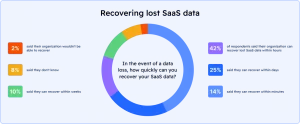
The frequency of attacks and data loss incidents in the cloud is only part of the story. Equally notable is the fact that businesses report poor rates of recoverability.
Only 14 percent of IT leaders were confident they could recover critical SaaS data within minutes. 25 percent said it would take days.
source: thehackernews.com
With downtime exceeding $300,000 per hour, such delays can severely harm the business.
The growing compliance costs of data protection failures
Beyond downtime costs, organizations now face significantly higher compliance penalties for inadequate data protection.
This stems from established regulations like DORA and NIS 2, whose impact intensifies from 2026 onward. At this stage, regulators are moving beyond formal adoption and into active enforcement, with audits, supervisory reviews, and fines being issued for non compliance, particularly where organizations have failed to invest in adequate data protection planning and testing. DORA, for instance, provides for fines of up to 2 percent of a business’s annual revenue – not to mention the possibility of individual liability for business leaders.
Traditional frameworks like GDPR focused on reasonable safeguards to protect sensitive data from cyberattacks and data leakage. Newer regulations also emphasize data backup and recovery to ensure IT infrastructure resilience.
SaaS data faces many threats
One of the top SaaS data protection challenges surrounding SaaS backup becomes even more acute when you consider the multifaceted threats facing SaaS data.
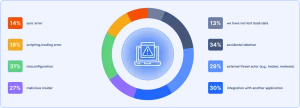
When asked what caused SaaS data loss in 2024 or 2025, businesses cited a wide range of factors. Malicious deletions (50%) and ransomware attacks (36.7%) were the most common data protection incidents.
Accidental deletions and SaaS misconfigurations were also common, causing data loss for 34% and 30% of businesses. Data syncing issues and scripting errors were also responsible for SaaS data loss for at least 14 percent of companies.
source: thehackernews.com
These findings stress protecting SaaS data from cyber threats as well as overlooked operational and human risks.
Not all types of SaaS data are equally protected
More granular SaaS backup data reveals which types of information businesses typically protect — and which they don’t.
For organizations that deploy SaaS data protection solutions, emails and email contact information data are usually covered. But other types of important business data – such as calendar events, files stored on shared drives and team chat or collaboration logs – are not always backed up, presumably because not all SaaS backup and recovery tools support this type of data.
Failing to protect this data doesn’t mean businesses won’t need to recover it after an incident.Imagine, for example, how much a sales team would struggle if an accidental data deletion event wiped a calendar where the team scheduled customer meetings, or how much time of a delay a product development team would incur in bringing a new feature to market if it lost all of the chat logs where engineers discussed implementation plans.
Backup monitoring remains a blind spot for many IT teams
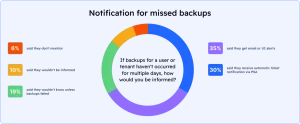
Many companies lack visibility into whether backups are actually working, regardless of the data they believe they protect.
35 percent of IT professionals don’t proactively monitor backups and would miss failures or detect them only through manual checks.
source: thehackernews.com
Automated backup notifications are a simple way to close this visibility gap. However, many IT teams either lack tools with this capability or have not configured them correctly.
Backup credentials are insecure
Protecting credentials that control access to backups is another area where many organizations fall short.
Only about a third of businesses follow the best practice of storing access credentials in enterprise-grade encrypted password vaults or managers. The rest rely on less secure measures, like hardcoding credentials into configuration files or adopting the catastrophically risky practice of writing down passwords on sticky notes – something that more than half of employees confess to doing.

Data protection is consuming more and more IT staff time
You might assume businesses struggle with cloud and SaaS backups because they’re allocating fewer resources.
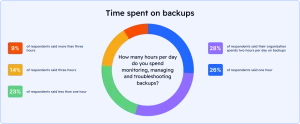
But actually, the opposite is true. Managing backups now consumes at least ten hours per week for IT workers at about half of organizations, a figure that has roughly doubled since 2022. Given that IT professionals earn about $100,000 per year on average, that works out to about $25,000 worth of staff time per IT engineer – an enormous strain on IT budgets.
source: thehackernews.com
To use IT budgets efficiently, businesses must improve data protection while reducing engineering time spent on backup and recovery. Automating backups helps, but many organizations still underuse automation despite spending more time managing backups than before.
Businesses report low confidence in data protection capabilities
Increasing time commitment to managing backups correlates inversely with data protection confidence.
As of 2025, only 40% of businesses feel confident in protecting their critical data from potential loss events. That’s down from 50 percent who said they were “very confident” in IT backup and recovery solutions circa 2020. About one third of IT professionals went so far this past year as to say that backup and recovery shortcomings were a source of “nightmares.”
The trend is clear: Even as businesses are dumping more resources into backup and recovery, they’re experiencing worse results.
The slow pace of backup and recovery modernization
These outcomes likely reflect, in part, the failure of the typical organization to modernize its backup and recovery solutions.
28 percent of businesses say they haven’t evolved their backup and recovery strategies within the past five years. That’s a problem given that IT strategies have changed significantly in that time. Not only have more workloads moved into the cloud or SaaS architectures, but organizations have also invested more in new types of cloud paradigms – such as switching from traditional cloud technologies to “cloud native” designs.
A trend toward switching backup providers
There are signs, however, that businesses are now finally starting to overcome their inertia by investing in new backup solutions. 73 percent of organizations surveyed in 2025 said they planned to switch data protection providers within the next twelve months.
When asked why, they cited a variety of reasons. Cost was a prime consideration, but so were technical considerations like the need for better disaster recovery testing, recovery automation and backup orchestration features.
This suggests businesses recognize the need to modernize data protection and seek tools beyond basic backups.
Conclusion
Overall, these statistics show that businesses face mission-critical SaaS data protection challenges.
The good news is that solutions exist. Increased use of backup automation, backup reporting, and recovery testing can go far to improve businesses’ confidence in their data protection capabilities. They can also reduce data protection costs and free up staff to focus on other tasks.
But not all data protection tools offer capabilities like these, which is why it’s a welcome sign that many organizations plan to evaluate new data backup and recovery solutions over the coming year. Here’s hoping they make the changes necessary to keep data safer, while simultaneously lightening the operational and financial burden that data protection places on businesses.